The Day I Realized My Silence Had Already Spoken for Me
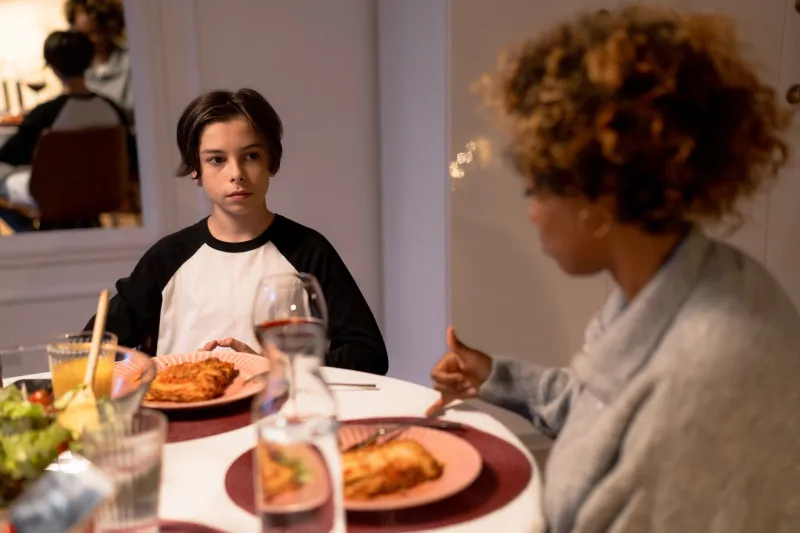
There's a particular kind of parenting logic that sounds airtight in your own head. You tell yourself you're sparing your kids. You're keeping the peace. You're not burdening them with things they're too young — or too fragile, or too everything — to handle. I ran that logic for almost a decade before it fell apart in a Walmart parking lot on a Tuesday afternoon.
My daughter was eleven. She'd gotten a bad grade on a test she hadn't told me about. I found out from her teacher in a casual email, the kind that starts with just wanted to keep you in the loop. When I brought it up in the car, she shrugged and said, "I didn't think it was a big deal."
But her eyes did something I recognized immediately. They went somewhere else. Somewhere interior. Somewhere safe.
I knew that look because I invented it.
What I Thought Protection Looked Like
I grew up in a house where feelings were managed, not expressed. Not cruelly — my parents weren't monsters. They were just people who'd learned that emotions were inconvenient, messy, and best handled privately. You cried in the bathroom. You smiled at the dinner table. You said fine so many times it stopped meaning anything.
When I had kids of my own, I made a conscious decision not to repeat that. I told myself I was different. I talked to my kids about kindness, about fairness, about what to do when someone at school was mean to them. I thought that counted.
What I didn't do was let them see me struggle. I didn't let them watch me work through something hard. When my marriage hit a rough patch, I kept it clinical and quiet. When I lost a job I'd loved, I reframed it as an "opportunity" before the dust had even settled. When my father died and I didn't cry at the funeral, I told myself I was being strong for everyone else.
I was performing wellness. And my kids had front-row seats.
The Pattern Starts to Surface
After the parking lot moment, I started paying closer attention. My son, who was thirteen at the time, had developed this habit of deflecting questions with humor. Not the warm, easy kind — the kind that puts a wall up and dares you to climb it. My daughter had started saying I'm fine the way I say I'm fine, which is to say: quickly, flatly, and with no room for follow-up.
I'd handed them a survival toolkit. The problem was, it was the same one I'd been given, and I knew exactly how poorly it worked.
I remember sitting with that realization for a few days before I could even say it out loud to myself. Because admitting it meant admitting that my silence hadn't been neutral. It hadn't been protective. It had been instructional. Every time I'd swallowed something hard, I'd been teaching my kids that hard things get swallowed. Every time I'd pivoted away from an uncomfortable conversation, I'd been showing them the exit.
They weren't lying to me because they were bad kids. They were lying to me because I'd shown them it was the safest option.
The Conversation I Didn't Know How to Start
I didn't have a plan. I want to be honest about that, because so much parenting advice makes it sound like breakthroughs come with a roadmap. Mine came with a lot of fumbling and at least one moment where I started talking and then just... stopped, because I didn't know how to finish the sentence.
I started with my daughter, mostly because the parking lot moment was still fresh. I told her I'd noticed something. I told her that when I asked about the test, she looked like she was bracing for something bad. And then — and this is the part that felt like jumping off a ledge — I told her that I thought I knew why.
I told her about growing up in a house where you learned to make yourself small around the hard stuff. I told her that I'd done it too, probably in front of her, more times than I realized. I told her that I didn't want her to feel like she had to manage my reactions by hiding things from me.
She didn't say much at first. She picked at a thread on her sleeve. Then she said, "I didn't want you to be disappointed."
And I almost lost it right there, because that sentence was so familiar it hurt.
Rebuilding Isn't a Single Moment — It's a Hundred Small Ones
I'm not going to tell you that one conversation fixed everything, because that would be its own kind of lie. What happened after that was slow and nonlinear and sometimes frustrating. My son took longer to open up — teenage boys don't exactly rush toward vulnerability, especially when they've learned to armor themselves with jokes. There were weeks where I thought I was making progress and then we'd hit a wall and I'd wonder if I'd already done too much damage.
What helped, weirdly, was letting them see me mess up in real time. Not performing mess — actually being in it. I remember telling my son that I was stressed about something at work and I wasn't totally sure how to handle it yet. He looked at me like I'd said something in a foreign language. Then he said, "What are you gonna do?"
And we just... talked about it. Nothing dramatic. But something shifted.
I started narrating my own emotional process more, not in a therapy-speak way, just honestly. I'm frustrated right now and I need a minute. That thing you said actually hurt my feelings — can we talk about it? I don't know the answer to that yet. Small sentences. Real ones.
Slowly, they started doing it back.
What I Know Now That I Wish I'd Known Earlier
Children don't learn emotional language from what you tell them. They learn it from what they watch you do with your own emotions — how you hold them, whether you name them, whether you treat them like something survivable or something shameful.
I spent years thinking that keeping my struggles private was a gift to my kids. What I was actually doing was teaching them that their struggles should also be private. That feelings were something to manage behind closed doors, not something to bring to the people who love you.
The cycle of emotional suppression doesn't require cruelty to continue. It just requires silence. And silence, it turns out, is one of the loudest things you can pass down.
I'm still working on this. We all are — me, my daughter with her sleeve-picking, my son with his deflection humor that's slowly, slowly, getting a little less sharp. We're not a family that has it figured out. But we're a family that's starting to say the thing instead of swallowing it.
That feels like enough. For now, it really does.