The Word That Broke Us Open — And Put Us Back Together Stronger

I used to think the most loving thing I could do was never say no.
Not to my sister. Not to the woman who called me at 11 p.m. from a parking lot, crying about a man who didn't deserve her tears. Not to the person who had been, for the better part of my adult life, the gravitational center of my emotional world. I answered every call. I dropped every plan. I showed up with coffee, with cash, with whatever version of myself she needed that day — and I told myself that was love.
I was wrong. But it took me a long time to figure out that what I was actually doing was disappearing.
The Arithmetic of Always Saying Yes
My sister Renee is four years older than me and about forty years more chaotic. I say that with love — the kind of love that's been tested and bent and stress-fractured and somehow still holds. She's funny and brilliant and has one of those personalities that fills a room before she even walks into it. She's also been in crisis, in one form or another, for as long as I can remember.
Growing up, I learned to read her moods the way other kids learned to read weather. A certain kind of quiet meant a storm was coming. A certain laugh meant she was okay, at least for now. I became fluent in her, and somewhere along the way I started to believe that my job — my actual purpose — was to be the person who kept her from falling apart.
So I said yes. Always yes. Yes, I'll drive you. Yes, I'll lend you money I don't really have. Yes, I'll call your landlord. Yes, I'll skip my own therapy appointment to sit with you through yours. Yes, yes, yes, until the word yes stopped meaning anything and started meaning I am here and I am yours and I have no edges of my own.
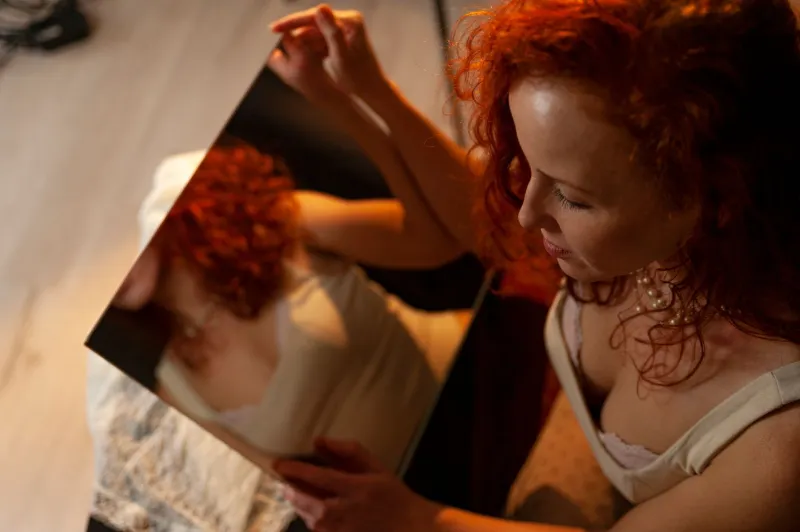
The arithmetic of always saying yes is brutal. You subtract yourself, a little at a time, until you look in the mirror and you're not entirely sure who's looking back.
The Night I Ran Out
The specific night I said no for the first time wasn't dramatic. That's the thing nobody tells you about pivotal moments — they rarely look like what they are when they're happening.
It was a Tuesday. I had worked a ten-hour day. I had a headache that had been sitting behind my left eye for three days. My own apartment was a disaster. I had not eaten a real meal since Sunday. Renee called at 8:47 p.m. and I looked at my phone and I felt something I had never consciously felt before: I felt nothing. Not love, not obligation, not the familiar tug of responsibility. Just emptiness. A tank that had been running on fumes for so long it finally clicked over to zero.
I let it ring.
And then I sat on my kitchen floor and cried for forty-five minutes, because I was convinced that not answering that phone call made me a terrible person and a terrible sister and possibly just terrible, full stop.
But here's what I also felt, underneath all that guilt: relief. A thin, fragile thread of it. And that thread scared me more than the guilt did.
What the Guilt Was Actually Protecting
I started seeing a therapist — a new one, one I hadn't canceled on — about two months after that Tuesday. She asked me a question in our third session that I've been turning over ever since.
"Who were you before Renee needed you?"
I didn't have an answer. I sat there in her beige office in a suburb of Columbus and I genuinely could not tell her who I was outside of being someone's lifeline. My identity had been so thoroughly organized around my sister's needs that removing myself from that role felt less like setting a boundary and more like an amputation.
That's when I started to understand that the guilt wasn't really about Renee. The guilt was protecting me from having to answer a much harder question: If I'm not the person who saves her, who am I?
And the honest answer, the one I'd been running from for years, was: I have no idea.
Learning the Language of No
Saying no to someone you love — really love, not the complicated, resentment-laced version of love that develops when you've spent years erasing yourself for someone — is not a single moment. It's a practice. It's clumsy and uncomfortable and it doesn't get clean all at once.
My first real no, the one I said out loud directly to Renee, came about four months after that Tuesday. She needed money. Again. And instead of the usual internal calculation — do I have it, can I spare it, what happens if I don't — I just said: "I can't do that right now."
She was quiet for a long time. Then she said, "Okay."
That was it. Okay. The catastrophe I had been bracing for my entire adult life did not arrive. The relationship did not end. The sky did not fall. She said okay, and we talked for a few more minutes about something completely unrelated, and then we hung up.
I sat with that okay for days. I turned it over like a stone I'd found on a beach. It was such a small word to carry so much weight.
What Grew in the Space I Made
Here's what nobody warned me about setting boundaries: it doesn't just change your relationship with the other person. It changes your relationship with yourself, and that part is both stranger and more significant than anything else.
When I stopped organizing my life around Renee's emergencies, I had to figure out what I actually wanted to do with my time. That sounds simple. It was not simple. I had to learn, at thirty-four years old, what I liked. What I needed. What I was like when I wasn't performing the role of someone's anchor.
Turns out I like silence. I like cooking meals that take too long. I like going to bed early and reading books that have nothing to do with anything useful. I like being bored, which I had not allowed myself to be in years. These are not revolutionary discoveries. But they were mine, and I had never let myself have them before.
Renee and I are still close. Different, but close. She has her own therapist now, and her own support system that doesn't run exclusively through me. Some of that is because I stepped back enough to let other people step in. Some of it is just her own hard work, which was always hers to do — I just kept getting in the way of it by doing it for her.
The Most Honest Thing I've Ever Done
I don't think saying no to someone you love is cruel. I think it might actually be the most honest thing you can offer them.
Because when I was always saying yes, I wasn't being generous. I was being afraid. I was saying yes to avoid the discomfort of her disappointment, to sidestep my own guilt, to keep myself in a role that felt purposeful even when it was hollowing me out. That's not love. That's management. And the person I was managing — my sister, my person, the one I would still walk through fire for — deserved more than a version of me that only existed in relation to her needs.
The no I finally said was the first truly free thing I'd done in years. It cracked something open between us that had been sealed shut for a long time. And what came through that crack, slowly and imperfectly, was something that actually looked like two real people who actually knew each other.
That's what I'd been trying to build all along. I just had to stop saying yes long enough to find it.